







The Philippine cold chain industry is entering a period of sustained expansion, driven by population growth, shifting consumer behavior, and the increasing importance of food safety and post-harvest loss reduction. Industry leaders project that the local cold chain sector will grow at an estimated 8% to 10% annually over the next five years, making it one of the faster-growing segments within the country’s logistics and food supply ecosystem.
At the center of this growth is a fundamental structural shift in how food reaches consumers. Traditional wet markets—long the backbone of Philippine food distribution—are gradually being supplemented, and in some cases replaced, by supermarkets and modern retail outlets offering chilled and frozen products. This transition is reshaping demand for cold storage facilities and, critically, for reliable refrigerated transport.
According to Anthony Dizon, President of the Cold Chain Association of the Philippines and a long-time industry expert, the movement away from purely “fresh” selling formats is the single biggest driver of cold chain expansion today. “As consumers become more aware of food safety and quality, chilled and frozen products are no longer viewed as premium or niche—they are becoming mainstream,” Dizon said. “This shift is pushing demand for cold chain capacity across storage, processing, and especially transportation.”
Data from industry groups and government agencies consistently show that post-harvest food losses in the Philippines remain significant, particularly in agricultural regions where access to cold chain infrastructure is limited. Improving refrigerated transport is widely seen as one of the most effective ways to preserve product quality, stabilize prices, and extend market reach for farmers and food producers.
While cold storage warehouses are being built at a steady pace, transport remains a key bottleneck. Last-mile and regional refrigerated delivery are under increasing pressure as food distribution expands beyond major urban centers into provincial and inter-island routes. This challenge is compounded by the Philippines’ tropical climate and relatively high electricity costs, which place a premium on energy-efficient cooling solutions.
It is within this context that Centro Nippon Fruehauf Cooltech Inc. (CFCI), in partnership with Sojitz Fuso Philippines Corporation, introduced the Fuso F-resh Refrigerated Van. Mounted on the Fuso Canter FE71, the F-resh Ref Van combines a proven Japanese commercial vehicle platform with a fully Japanese-designed and engineered refrigerated body system based on Nippon Fruehauf technology.
Dizon emphasized that the next phase of cold chain growth will demand higher operating efficiency and reliability. “The industry has embraced state-of-the-art technologies because sustainability of investment is critical,” he noted. “Operators are looking for solutions that reduce spoilage, manage energy costs, and perform consistently across longer and more complex delivery routes.”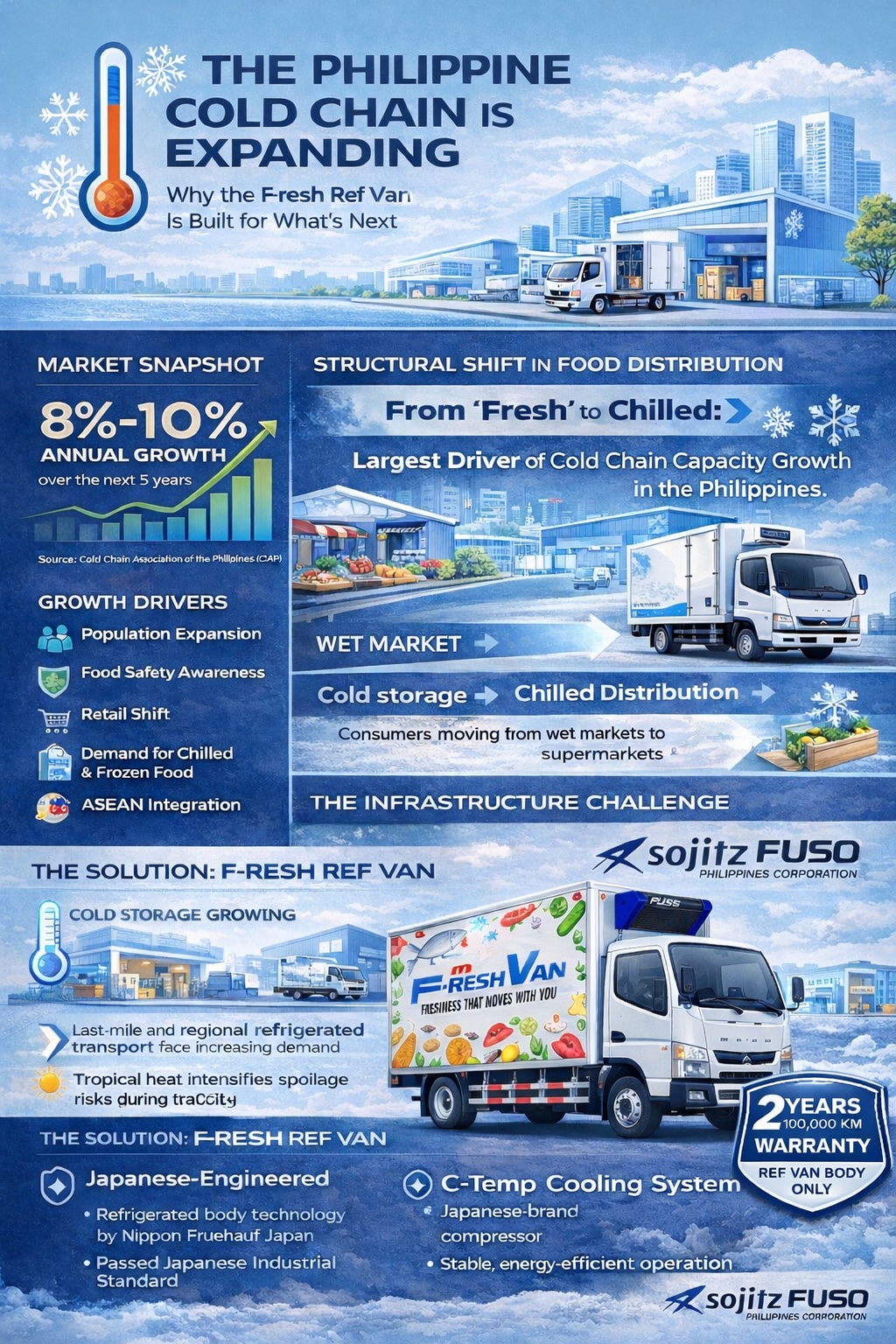
The F-resh Ref Van addresses these requirements through high-performance insulation using Extruded Polystyrene (XPS), recyclable aluminum panels, and a C-Temp refrigeration system equipped with a Japanese-brand compressor known for stable temperature control and energy efficiency. These features are particularly relevant as businesses seek to balance operating costs with stricter food safety standards.
To further support fleet operators and investors entering the cold chain space, the F-resh Ref Van is backed by 2 years or 100,000 kilometers of warranty coverage, reinforcing confidence in long-term performance and after-sales support.
As the Philippine cold chain industry continues its steady climb, refrigerated transport solutions like the F-resh Ref Van are emerging as critical enablers of growth—linking farms, processors, retailers, and consumers in a more resilient, efficient, and safer food supply chain.