
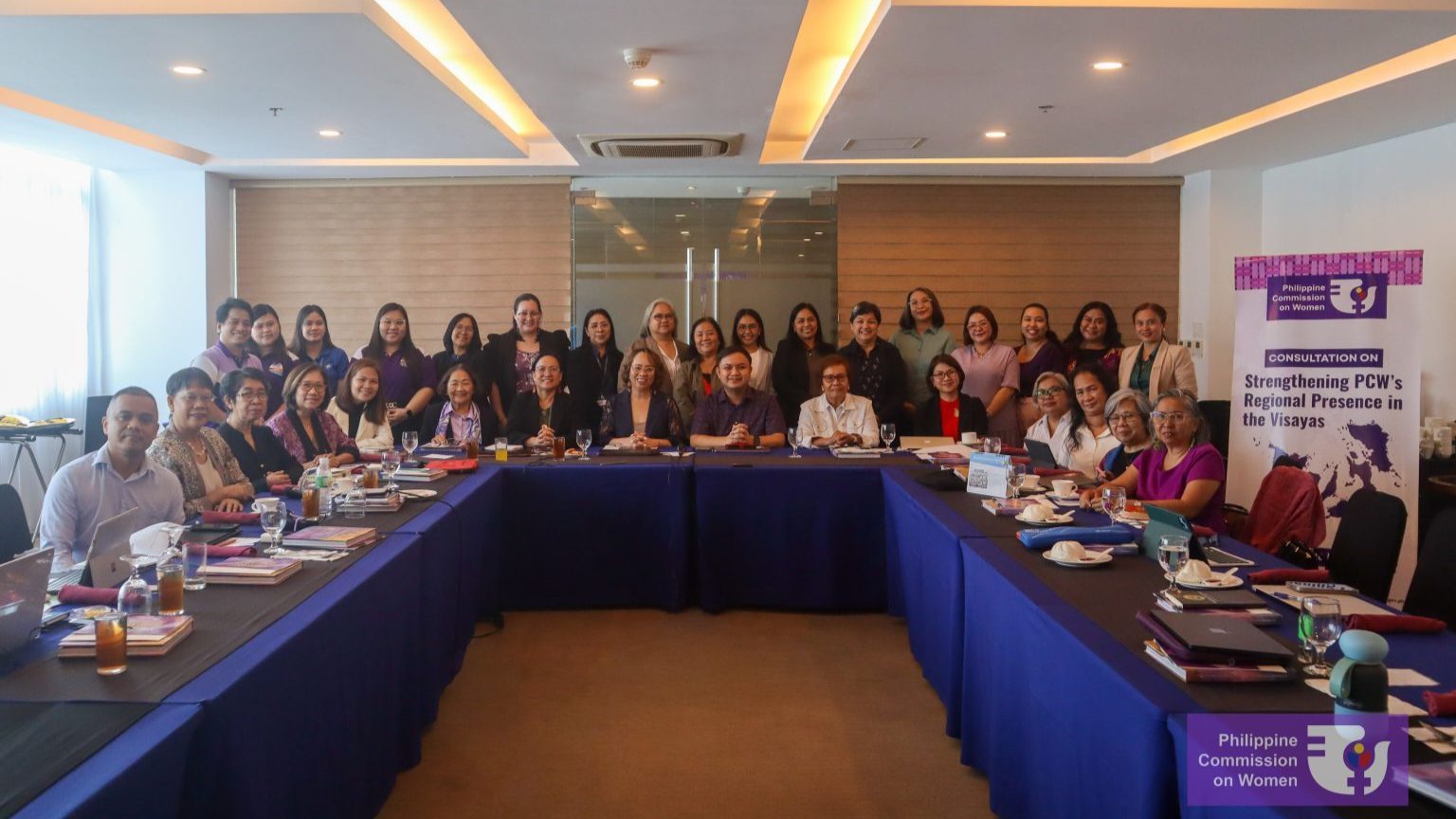






The Philippine Commission on Women (PCW) convened regional stakeholders from across the Visayas on August 11 to consult them on a proposed regional presence that could bring the Commission’s technical assistance, policy support, and other services closer to communities in the region.
Twenty-three stakeholders participated in the consultation, including nine representatives from civil society organizations and 14 representatives from Regional Gender and Development Committee (RGADC) members from Western Visayas, Central Visayas, Eastern Visayas, and the Regional Development Council – Negros Island Region.
The consultation is part of PCW’s phased and evidence-informed approach to determining the most appropriate organizational model for strengthening its regional operations in the Visayas, building on the Commission’s experience with the North Mindanao Field Office.
Bring PCW closer to women
PCW Chairperson Ermelita V. Valdeavilla set the tone for the day, calling on the Commission and its partners to finally act on an ambition PCW has carried since its establishment. “It is time to give birth to a 51-year old ambition to get closer to our women,” she said. “It is time to rise up today and be the mananabang of PCW regionalization”—invoking the traditional Bisaya term for midwife to describe the work ahead.
She emphasized that distance can become a barrier between policy and impact. “Distance forces generalization, but proximity restores specificity,” Valdeavilla said. “A national commission can set the standard in Manila, but only proximity will see whether those standards work for women.”
PCW Executive Director Nharleen Santos-Millar provided an overview of the Commission’s decades-long efforts to localize the implementation of the Magna Carta of Women. She traced these efforts to the National Commission on the Role of Filipino Women’s Institutional Strengthening Project Phase II, funded by the Canadian International Development Agency. The project established regional partnerships and GAD Resource Centers in priority areas in the country. These initiatives later evolved into the Local GAD Resource Program and the Regional GAD Committee (RGADC) network, followed by the GAD Local Learning Hubs and, most recently, the North Mindanao Field Office.
She framed the Visayas initiative as the next logical step in this continuing localization effort, emphasizing that PCW would build on lessons and mechanisms already developed rather than start from scratch.
Co-designing a regional presence
Through regional situation analysis and co-design discussions led by PCW Chief GAD Specialist Kim Harold T. Peji and Supervising GAD Specialist Neil Ryan P. Rodil, participants identified priority gender and development concerns. They also shared their perspectives on the functions, coverage, and organizational arrangements that a PCW regional presence should have.
Among the concerns highlighted were gaps in gender data and knowledge management; challenges in strengthening GAD mechanisms and institutionalization; weaknesses in GAD planning, budgeting, monitoring, and accountability; and continuing issues related to gender-based violence, poverty and economic vulnerability, climate and environmental concerns, unpaid care work, and women’s economic participation.
Participants also emphasized the importance of accessibility, responsiveness, and strong partnerships with existing regional mechanisms. They expressed support for a regional presence that would complement rather than duplicate the work of RGADCs, regional line agencies, local government units, state universities and colleges, civil society organizations, and other regional partners.
The proposed regional presence is envisioned to serve more than 21 million people across the four constituent regions of the Visayas.
Closing the day’s proceedings, PCW Deputy Executive Director for Operations Anita E. Baleda thanked participants for a substantive consultation. “We are not selecting a final model today,” she said, explaining that the day’s outputs would instead inform a draft Regional Operational Model to be brought back to stakeholders for validation later this year.
From consultation to action
Inputs from the consultation will be consolidated and considered alongside regional gender data, existing PCW localization initiatives, and other evidence in developing the draft Regional Operational Models and Regionalization Design Report.
The draft models will subsequently be presented to regional stakeholders for validation to determine whether the proposed arrangements respond to the needs and priorities identified during the consultation and to identify areas for further improvement.
The consultation also contributes to PCW’s broader efforts to strengthen regional GAD mechanisms nationwide, including its assessment of the compliance, functionality, and institutionalization of RGADCs under NEDA-PCW Joint Memorandum Circular No. 2016-01.
These efforts come as the country marks the 17th anniversary of the Magna Carta of Women, the landmark law that has anchored the Commission’s mandate to advance gender equality and women’s empowerment since its enactment in 2009.
A regional presence in the Visayas would mark a tangible step toward that goal—bringing PCW within closer reach of millions of women across the region.